For CPGs and pharma companies managing track and trace, shorter production runs, SKU proliferation, regional packaging variations, and even emerging examples of mass customization, conventional labeling workflows can create operational friction. Large inventories of pre-printed labels require storage space, changeovers consume production time, and introducing limited-edition or test-market packaging can become costly.
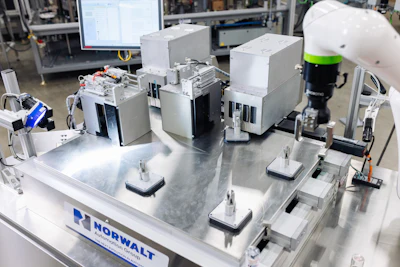
To address those challenges, Norwalt Automation Group developed a direct-to-object printing platform designed to handle multiple package geometries with software-driven flexibility rather than dedicated mechanical change parts. The machine, called the Tesseract, combines digital printing with Beckhoff’s XPlanar magnetic planar transport system and a PC-based controls architecture.
The resulting system allows packages to move independently beneath printheads while rotating, translating, and adjusting position dynamically during the print process.
“We had a big push towards flexible machinery so customers could go about different business concepts like customization with print, or better demand forecasting,” says Kyle Seitel, Norwalt technical sales director.
The family-owned machine builder, headquartered in Randolph, N.J., serves industries including packaging, pharmaceuticals, food and beverage, and digital printing. According to the company, increasing demand for regionalized SKUs, seasonal packaging, and shorter product runs pushed Norwalt toward a more flexible direct-printing approach. Norwalt’s advanced printing machines print labels directly on a variety of container dimensions and materials instead of traditional adhesive labels.Beckhoff/Norwalt
Moving beyond conventional labels
Traditional label-printing workflows often rely on large reels of pre-printed labels, which can create storage requirements, inventory exposure, and material waste during changeovers or product updates.
“A lot of time, what happens in the CPG market is costs start shooting through the roof because you’re ordering large reels of labels, you have to hold them in an air-conditioned unit, and it takes up a lot of space that could be dedicated to other manufacturing,” says Seitel. “When you move to direct-to-object printing, you’re basically replacing label reels with ink. A bottle of ink goes a long way and doesn’t need to be put in a special room. Lowering costs.”
Norwalt’s goal was to create a machine capable of printing directly onto a wide range of package geometries while minimizing mechanical changeover requirements. Conventional direct-to-object systems can struggle with irregular or tapered containers, often requiring dedicated fixturing or fixed-motion systems tailored to a specific package. XPlanar movers can float and fly with 6 degrees of freedom, so containers are moved optimally around the printheads for high-quality labeling.Beckhoff/Norwalt
The Tesseract instead uses software-defined motion to reposition packages dynamically beneath the printheads.
At the center of the system is Beckhoff’s XPlanar technology, which uses magnetically levitating movers traveling across planar tiles. Each mover can independently transport and position a package while coordinating movement with the printing process.
The approach allows packages to rotate 360 deg, move in X and Y coordinates, and adjust Z-axis height as much as 5 mm during printing. According to Norwalt, that flexibility helps the machine accommodate a broader range of package shapes without extensive mechanical reconfiguration.
Norwalt says the original concept emerged after company engineers saw an XPlanar demonstration and began exploring whether planar transport could simplify direct-to-object printing for multiple container geometries.
“That’s the real beauty of XPlanar--as we run out of room, we can just keep adding tiles,” says Seitel.
The machine’s modular architecture also allows print stations and planar tiles to be expanded as throughput requirements increase. A robot removes containers from the magnetically floating XPlanar movers when printing is complete.Beckhoff/Norwalt
Software-defined package handling
In the Tesseract system, containers are loaded onto XPlanar movers by a robotic handling system before being transported through the print area.
Rather than relying on fixed mechanical timing, package movement is controlled through software-defined motion profiles. Packages can rotate or reposition dynamically beneath the printheads while maintaining synchronization with the print process.
“We don’t have to modify any of the Tesseract’s mechanical components. We can do everything on the fly with just the press of a button,” says Norwalt Controls Engineer Darshan Nayee.
Norwalt used Beckhoff TwinCAT automation software as the development environment for motion control, PLC functionality, HMI, and safety integration. TwinCAT runs on a Beckhoff CX2062 Embedded PC platform.
For additional motion control tasks, the machine uses ELM7212 servo terminals and AM8000 servomotors connected over EtherCAT. DIN rail mounted ELM7212 servo terminals and connected AM8000 series servomotors control printhead positioning to ensure smooth overlay of multiple ink colors.Beckhoff/Norwalt
According to Norwalt, EtherCAT communication helped maintain tight synchronization across distributed motion and I/O devices while also simplifying commissioning and diagnostics. Instead of manually configuring large numbers of networked devices individually, engineers can scan the EtherCAT network to identify connected components and troubleshoot wiring or communication issues more quickly.
Machine safety functions are integrated through TwinSAFE I/O terminals and Safety over EtherCAT (FSoE).
The operator interface uses TwinCAT HMI software displayed on Beckhoff CP22xx multi-touch Control Panels and CP3xxx Panel PCs. Norwalt also incorporated a PackML state machine into the HMI structure.
Modular software approach
Norwalt says the project also pushed the company toward a more modular software-development strategy.
Using TwinCAT’s structured text and object-oriented programming capabilities, engineers developed reusable function blocks, motion profiles, properties, and methods that could be standardized across machines.
The text-based software environment also allowed the company to adopt conventional software version-control practices including branching, commits, and merges.
Norwalt says that reduced programming and software-merge time while simplifying machine updates and field modifications.
The company also worked closely with Beckhoff USA’s Special Projects Team during development and integration.
“I couldn’t have asked for better people to get me to a point where I can take projects and run them on my own,” says Michael Forte, controls engineer at Norwalt. Precise control and tightly synchronized EtherCAT communications allowed multiple color passes with the registration accuracy required for high‑quality results.Beckhoff/Norwalt
Printing flexibility and reduced mechanics
Norwalt says the Tesseract project delivered benefits in both machine flexibility and mechanical simplification.
By replacing portions of traditional mechanical transport systems with planar motion, the machine reduced the number of conventional moving components and mechanical change parts required for different package formats.
“Mechanically, it reduces the cost of a machine by 30% to 40%, saving hundreds of thousands of dollars,” says Keith Harman, Norwalt’s executive business director.
The machine’s smaller footprint can also help reduce floor-space requirements, according to the company.
Fewer mechanical components also reduced maintenance requirements and simplified troubleshooting.
“And for any errors we do get, 95% of all fixes can be handled remotely because there’s no mechanical failure to correct,” says Harman.
Norwalt also says the synchronized motion architecture improved print registration accuracy during multiple color passes. The ability to dynamically adjust package height using XPlanar movers helped support print consistency across varying container geometries without mechanical repositioning.
Together, planar transport, synchronized motion control, and software-defined package handling allowed Norwalt to build a direct-to-object printing system capable of accommodating a wider range of package types than conventional fixed-motion systems.
For Norwalt, the project represented an effort to simplify changeovers and expand packaging flexibility through software-driven motion control rather than relying on dedicated mechanics for each package format.